Help Save this Historic Brighton Cultural Asset!

Updated: Apr 21
Former Town Hall, Public Works, Library, Senior Center, & Future Cultural Asset
Brighton Treasure at Risk of Demolition

On Feb. 19, 2026, the City of Brighton requested a Certificate of Appropriateness (“COA”) before the Historic Preservation Commission (the “HPC”) during a Public Hearing for total demolition of the former Brighton Town Hall, also known as the Old Senior Center. The historic building is located at 575 S. Bush St. and is owned by the City of Brighton. It has also been used as the Public Works Building and Library throughout the years.
The HPC voted to deny the request, after reviewing and finding the Certificate of Appropriateness (COA) did not conform to applicable demolition COA criteria. The HPC also reviewed and denied the City’s request for an exemption from the COA requirements. They found that the building is structurally sound, although in need of repairs
However, the City appealed the decision in early March and the request will go be before the City Council in a Public Hearing April 21, 6:00 in Council Chambers at City Hall, 500 S. 4th St.
Read on to learn more about how you can help save this historic treasure.
Email or Call Your City Council Reps Today - Before Its Too Late!
You can help save this building today. Remember the Mayor and City Council represent your voice. BUT, THEY MUST HEAR FROM YOU. This building is at risk of demolition if your Mayor and Council Reps don't hear from you. Send an e-mail or call them TODAY--BEFORE IT IS TOO LATE! Contact the Mayor and each of your Ward representatives. Simply ask them to Please DO NOT DEMOLISH the 575 S. Bush St. property, renovate & occupy it. You can also tell them why it is important to you; Perhaps you have a memory to share. Don't be shy. Remember they need to hear from us to represent our concerns.
Don't know your Ward #? Here is the Ward Map of Brighton to help:
Mayor Greg Mills: gmills@brightonco.gov , (303) 655-2268
Ward 1: Tom Green tgreen@brightonco.gov, 303-655-2261
Ward 1: Rhianon Collins rcollins@brightonco.gov, 303-655-2265
Ward 2: Jim Snyder jsnyder@brightonco.gov, 303-655-2264
Ward2: Ann Taddeo ataddeo@brightonco.gov, 303-655-2266
Ward 3: Melinda Carbjal mcarbajal@brightonco.gov, 303-655-2263
Ward 4: Lloyd Worth lworth@brightonco.gov, 303-655-2260
Ward 4, Mayor Pro Tem: Peter Padilla ppadilla@brightonco.gov, 303-655-2269
Show Your Support at April 21 Public Hearing
We have heard the community's voice to save the 575 S. Bush St. Property from demolition. BUT HAS THE CITY COUNCIL HEARD YOU? Please show your support by attending the April 21 public hearing Public Notice COA for 575 Bush Street Tuesday April 21 at 6:00 PM, Meeting in Council Chambers, first floor 500 S. 4th Ave. Please plan to attend in the audience, and if you feel inclined to speak that would also be helpful. Tell your memories, voice your opinion to save this historic place. If you plan to speak, please show up in advance and complete a short form so you will be called to speak.
Your Voice Counts –Please Sign the Petition!
We need your support by signing the following electronic online petition:

SIGN THE ONLINE (electronic) PETITION to Save this Historic Brighton Treasure:
Neighbors and other concerned Brighton citizens have organized an effort to ask the City Council to abandon plans to demolish the building and instead pursue repair and re-use the building. Local Arts & Culture organizations, the HPC, and many residents outside the Brighton area (who work and enjoy Brighton) have also joined the effort. The group presented petitions totaling 339 signatures to the City Council on Mar. 17 and Apr. 7, requesting the City Council stop demolition plans and instead use current funds designated for this effort instead toward repairing and bringing the building up to code with the intention of re-use as a small meeting and event center, office for cultural organization, or Re-Use Ideas for the Historic Building collected in Brainstorming Sessions and Outreach by the group. The petition also suggests supplementing costs with historic preservation grants, fund-raising, and local company sponsorships and volunteer efforts. Community service days for those interested in donating their time to help renovate the building (from minor painting or expert tradesman) was another idea. Some in the brainstorming group even offered to help bring the landscaping up to code with gardening tasks or plant donations. Corporation donations and employee volunteers would also help save costs. An Eagle Scout project would also be welcome and benefit both the Scout and the facility, as former Eagle Scout projects have at the Elmwood Cemetery.
The group is continuing to collect additional signatures to present at the April City Council sessions and Public Hearing. Your voice is integral to the success of saving this building. Please sign the on-line petition today https://forms.gle/gy9nLWgq81gb7Jg5A.
Re-Use Ideas for the Building

So far collected ideas for a new building use include one or a combination of the following: A small events and meeting facility (long-term or by the day); Rental One or More Cultural Organizations (One local group as already expressed interest.); or a small business incubator. One suggestion included using the building for a Neighborhood/City Community Center with rentals for graduation and other celebrations/parties. Cultural Exhibits would not only produce a rental income but also enhance Brighton residents with cultural heritage. Rooms could be rented for Boy and Girl Scout and other organizational meetings. Suggestions include ideas for use as a special exhibit rental or scrapbooking group event site; or a traveling museum (small exhibit collaborations between Colorado museums).
How about a coffee shop or yoga studio or massage therapy rental? Local high school career-course students could highlight their culinary and other skills. Theatre and Dance Groups could rent the space and hold performances. The building is also ideal for Non-Profit office rentals; Business-for-a-Day Rentals (think small business open houses, antique Sales, Mary Kay and other home business events, or small hand-assembly craft or manufacture). Ideas were als presented to use the building for Arts and Culture events. A Gallery for a Day (artist and/or author display sales) and other creative ideas, such as a Workshop for a Day have been suggested. The building is ideal for training session rentals by local organizations. Another popular idea is a Children’s Museum (similar to Lafayette WOW museum); Children's Exhibits or Rentals for Arts & Crafts or Birthday Parties were also suggested. More ideas include: an America 250th Anniversary Photo Exhibit; Student Art Displays; Rentals for Artist and Writer Workshops; Bible Study Gatherings; A Rental for Church Services or a community of churches to rent for after-Church congregation get-togethers.
Proposals with interested investors have included making the building a bed and breakfast and creating a non-profit trade school, similar to Denver's Emily Griffith Opportunity School.
Supplemental ideas for outside use include a wall Mural, maybe even a Changing Student Art Canvas; Sculpture Garden; Community Garden; Small Neighborhood Park (splash pad, winter ice pond, The building could be used as a Coffee shop / Park Refreshment Shop with summer snow cones, etc.); and an Educational Facility.
We would love your ideas for what you would like to see in this building to help preserve it for this generation and the next. Send us your ideas using the Contact Form located at the bottom of our Home Page of this blog's host.
A Special Building History Corner
A special exhibit(s) inside the refurbished building could pay tribute to its history and transformations over the years. Creating a sense of historic place for both young and old with such artifacts as antique water and utility records, Senior Center craft fair photos, early library records, and a library card catalog. (If you are asking what the last item is, you are going to really enjoy this exhibit!)
Brighton Historic Landmark - Creating a Lasting "Sense of Heritage"

The City Council designated the Brighton’s Former Town Hall as an Historic Landmark of Brighton in 2014.
Brighton's Early Town Hall
The 575 S. Bush St. building served as Brighton's Town Hall, where Brighton's first Mayors led the town that would last through the generations as a community of multi-cultural heritage and agricultural pride. It housed our early mayors and other government officials, representing Brighton citizens. These citizens met regularly in the Assembly Hall to freely speak of their concerns and policies that would enhance the quality living for the community. They also gathered in the Assembly Hall for social occasions that brought them together neighbor to neighbor.
Marriage licenses were obtained from the City Clerk and licenses/permits obtained to enhance their farms and businesses.
The Lasting "Sense of Place of our Cultural Heritage"

Local historian Robin Kring recently shared a story with City Council of how a historic property can give Brighton citizens a “priceless sense of place” of our cultural heritage.
"I was asked by a local Charter School to provide a historical timeline to the Historic Brighton @ Founders Plaza Mural at Main & Bridge, of which I had the honor to write the background history. The teachers of the third graders used this new timeline and the background history to develop a curriculum around BRIGHTON’s HISTORY. They presented it in various history, geography, social study, & art classes. The teachers took photos of the mural and presented the photos along with historic photos of the buildings in various learning activities.
The students were very excited to learn about Brighton’s history and their own local heritage. BUT THEY WEREN’T SATISFIED with just a photo of the mural or photos of the historic places. The third graders asked to actually VISIT AND EXPERIENCE THE MURAL and the remaining buildings IN PERSON.
These children were expressing their desire to EXPERIENCE a sense of historical place that the actual historic location can produce. A Photo can’t do justice to the ACTUAL EXPERIENCE of SEEING it with your own eyes. A “sense of cultural place” is experienced by Walking into and standing in the same building once used as Brighton’s EARLY TOWN HALL, PUBLIC WATER WORKS BLDG, EARLY LIBRARY, and SENIOR CENTER.
Being able to see it in person --- to touch it--LET’s BOTH YOUNG People like this 3rd Grade class and the rest of us, experience the sense of historical place IN PERSON-- up close and personal.
Please consider saving 575 S. Bush St. from demolition and repairing & preparing for occupancy in order TO CREATE THAT “SENSE OF PLACE” experience for this generation--and the next.
Remember, once an historical cultural asset is destroyed—it is gone forever!"
The Town Hall's Classical Revival Architectural Style
The brick portion of the building is the former Brighton Town Hall was built in 1919 using a Late 19th & 20th Century Revivals/Classical Revival architectural style and was the first building built specifically for municipal purposes in Brighton. It housed the mayor and clerk’s offices in the front, and behind it had a large 20’ x 40’ Assembly Room, which doubled as Council Chambers and a community room.

Fun Fact Discovery The late historian, Patricia “Pat” Reither discovered a Feb. 13, 1919 record requesting the City Council to allow Brighton's young people to have dancing parties in the Assembly Room of the new building. It was granted as long as a dance permit was issued to the youth for $15 each.
The building was later known as the City Water Department and Municipal Building. A rear addition (as shown in a 1920 Sanborn map) is considered original to the building). It was used to house fire equipment for the Fire Department until the 1950's when the city built the Municipal Building and Fire Station between South Main and Cabbage Avenue. A brick outbuilding was built sometime after 1948.
Architect William Redding

The structure was built by architect, William Redding, from Denver known for his designs of other buildings throughout Colorado and Wyoming. His firm, WM Redding & Son, also built the Hotel Boulderado, shown below. The engineer for the pump house on the same property was Peter O’Brien, and the consulting engineer was R. D. Salisbury.

DF Carmichael & Brighton’s First Waterworks

Its history can be traced back to Brighton’s founder, DF Carmichael “The Father of Brighton,” who originally owned and donated the land as the first Brighton waterworks in 1891. He also started the formed the Brighton Water and Electric Company. At that time the S. Bush St. building was known as the Municipal Pump House & Town Hall.” Several wells and a pump house on the property provided water moved water into the water tank that connected to the water line infrastructure serving residents of Brighton for many years.
Fond Memories as the Library

By 1946, the library moved into the building. Many residents have shared their fond memories of this use, still remembering librarians by name. Stella Kaster was the librarian in the 1950's, followed by Mrs. Batz in the 1960's. Former students remember Layne Thompson’s mother was the librarian for years. Another remembers a librarian named Miss Castor.
“(Referring to Mrs. Batz) Remember you couldn't talk . . . You HAD to be quiet!
The former students told of the elementary schools not having extensive libraries so their teachers walked them over to the library from time to time. their teachers walking them over to the library.
One former student reminisced, “I used to go in there (the library) when I was little. My grandma lived across the street.” Another shared, “I loved the smell books.” “Such a wonderful and helpful lady,” one said.
More memories included, “I spent a lot of time there borrowing books to read and researching. It smelled like old books and the floor creaked.” One man reminisced his boyhood memories, “It was awesome to grab a few books, check them out, then race out the door and down the stairs before the old backroom librarian caught me for overdue books.”
Still more fond memories, “I remember going there on grade school trips and they would read us a story, I remember the old card system.”
Another, “(I) used to go there with my friend and lay on the grass reading and eating one of those red-white-blue bomb pops in the summer.”
Said one resident who grew up in Brighton. I loved that library! I was sad when they built the new one.
Many simply but fondly said “I loved that library.”
Even the basement with its huge pumps brought back some fun memories, especially when remember when they would not shut off due high fill pressure and the water would pour out from the tank. Fun in the summer!
Several told of “good times” loading a school bus in the Library parking lot to ride to weekly for swim lessons at Fitzimmons, before Brighton’s public swimming pool opened at Benedict Park in 1958. Laughingly, one claimed, “I think they were trying to drown me.”
The S. Bush St. Library memories remain vivid long after the library became part of Adams County Libraries in 1970 and the Brighton branch later moved to 575 8th Ave. on Aug. 3, 1972.
The Senior Center Years

In 1976, the interior of the 575 S. Bush St. building remodeled and refurnished to use as a Senior Center, using a federal grant. The east addition was added in 1986 with another federal grant to include a kitchen, cafeteria, and community room. Accessible doors were installed in 1995. In 1999, the kitchen was remodeled, an interior wall removed, and a drop ceiling installed.
Seniors held bazaars and rummage sales to add needed equipment. Over the years, the building housed many senior and community events, until the new Eagle View Adult Center at Prairie Center was constructed is the spring of 2011, which prompted the vacancy of the structure.
events.
The Mischievous Water Tower Comes Down

Carmichael would never have imagined the stories the water tower that replaced his original wood water tower would tell. Or, did he, too, experience mischievous youth climbing the original wood water tower? There is something about the calling of the tall structure that begs school boys “to climb me.” Historian Reither told that during the I980's, it became tradition for some members of the senior high school to climb the tower, whose legs straddled the building to paint their senior year number on the side of the tower reservoir. One former student reminisced, “I climbed the water tower many times. My great grandparents lived right next to it. I miss those days.”
Another shared, “I remember when someone, I won't stay who, painted ‘74’ on it.”
“I remember each class would climb up there and put (paint) their class year!” said another.
One woman confessed, “Always wondered what it would be like to climb it! Hated when they tore it down.”
Other comments, included “Ask some of the boys from the Class of 1974 what it was like! I did (it). The police would take me home and I would get a spanking.”
“It was a landmark. Surprising that all the boys didn't try climbing it. Or did they and they just didn't get caught. Hmm.”
“I’m sure it was a nice view from up there. We used to go there to smoke. We knew the cops would never go up there.”
And, “I climb it. What a trip!”
No longer in use and obviously recognized as a safety hazard, the water tower was removed between 1989 and 1993. A needed parking lot replaced part of its footprint.
A “Sense of Historical Place” Abandoned

After the Senior Center built and moved to a new location, the building was used for City storage and occasional youth events.
The first few years after the award of the 2014 Historic Landmark Designation, the City performed various maintenance, such as a new or repaired boiler system and roof in 2016. The front concrete stairs were replaced to match early designs as close as possible.
In 2016, The Brighton Housing Authority (BHA) drew up plans for the Water Works Apartments, a senior housing project. Year by year the project did not appear to be moving forward. Neighbors were not officially notified, but finally heard (through documents published in the recent and separate 2026 COA public hearing) that the project was abandoned after BHA was unable to obtain grant monies. Ownership of the property, which at one time was transferred to BHA sometime near 2016 was returned to the City.
In recent years, the site was considered for the City of Brighton Museum. However, a final decision to move the museum in another historic Brighton building, the 1886 Church. Grants to help improve some structural issues have recently been received and the old State Farm building (a home converted to a business office) was purchased for the museum offices and public restroom.
The Historic Town Hall's Condition Today
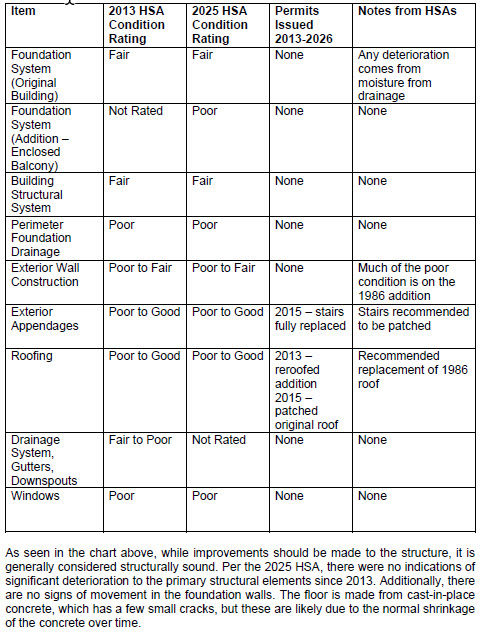
According to HPC in the recent 2026 COA for Demolition Public Hearing (excerpted here), the site does not present a structural hazard at this time. The structural integrity of the site has been analyzed twice through Historic Structural Assessments. Historic Structure Assessments (“HSA” or “HSAs”) are detailed investigations of historic structures that evaluate the condition of building systems, provide a prioritized list of corrections/ improvements, and provide cost estimates for that work. Per the 2025 HSA, there are no indications of significant deterioration to the primary structural elements. — HPC
As seen in the chart below, while improvements should be made to the structure, it is
generally considered structurally sound. Per the 2025 HSA, there were no indications of
significant deterioration to the primary structural elements since 2013. Additionally, there
are no signs of movement in the foundation walls. The floor is made from cast-in-place
concrete, which has a few small cracks, but these are likely due to the normal shrinkage
of the concrete over time.
Total demolition of the structure leaves no opportunity to fill the vacant building to remedy the non-structural hazardous conditions currently present.
Although the City first honored the maintenance and security requirements for the landmark ordinance, maintenance, in the years since 2016 the building has fallen in disrepair and experience some severe inside vandalism. Calls regarding vagrancy and possible break-ins have been documented in the 2026 COA package. One specific incidence caused severe damage to walls ceilings and torn out fixtures. Some neighbors have complained that there is lax security. And in reality, abandoned structures are quite vulnerable to vandalism. Neighbors have expressed that repair and occupancy, vagrancy risks greatly reduced, if not completely eliminated. Furthermore, we have posed the question whether reimbursement of damages from the person(s) who commitment the vandalism have been sought and/or have been or could be recovered.
The Case for Asbestos Abatement Savings

For the 2025 COA Demolition Public Hearing, the City hired White Hat Services, LLC to perform a Pre-Demolition Asbestos Building Inspection assessment of asbestos in the building requesting a full abatement of the hazard in anticipation of demolition. Estimated costs for abatement were not published in the Hearing or in the following month’s HPC minutes.
However, we have asked the City to consider the savings of repairing and containing asbestos while repairing a building vs. the need to full asbestos abatement required during a full demolition process. One expert explained at the March 17, 2026 Council meeting that some repairs can be made by special painting/taping and enclosures, depending upon the area identified. This would reduce abatement cost estimates considerably.
Historic Sites Enhance Quality of Life & Produce Economic Benefits

Deciding to demolish or to restore is not solely about “dollars and cents.” The Economic Benefit of Historic Preservation
The City of Brighton’s current (2016) Comprehensive Plan has surveyed and interviewed the Brighton public in surveys and workshops to gather public input into what we want for our community. Principle 10: Preserve Historic Resources to enhance the Community’s Quality of Life and Heritage details the City’s commitment to the Brighton public’s desire to preserve historic places to enhance our lives, including: “Identifying uses for historic properties to ensure proper, ongoing maintenance.” Our petition is asking for the City to honor this commitment. Download and review the 2016 City of Brighton Comprehensive Plan in detail here:
Consideration for saving the historic Town Hall building should not be based on dollars and cents evaluation along. Consider that preserved historic buildings generate a vibrancy that contributes to generating income and attractiveness of nearby retail and businesses. In other words, a restored and occupied 575 S. Bush St. property would not only add to our quality of life but will bring economic prosperity to nearby businesses and neighborhood values. The economic benefits of historic preservation not only benefit the immediate neighborhood but also extend to the city (Brighton) and Colorado. These economic benefits are detailed in the following publication by History Colorado and Colorado Preservation, Inc.:


